
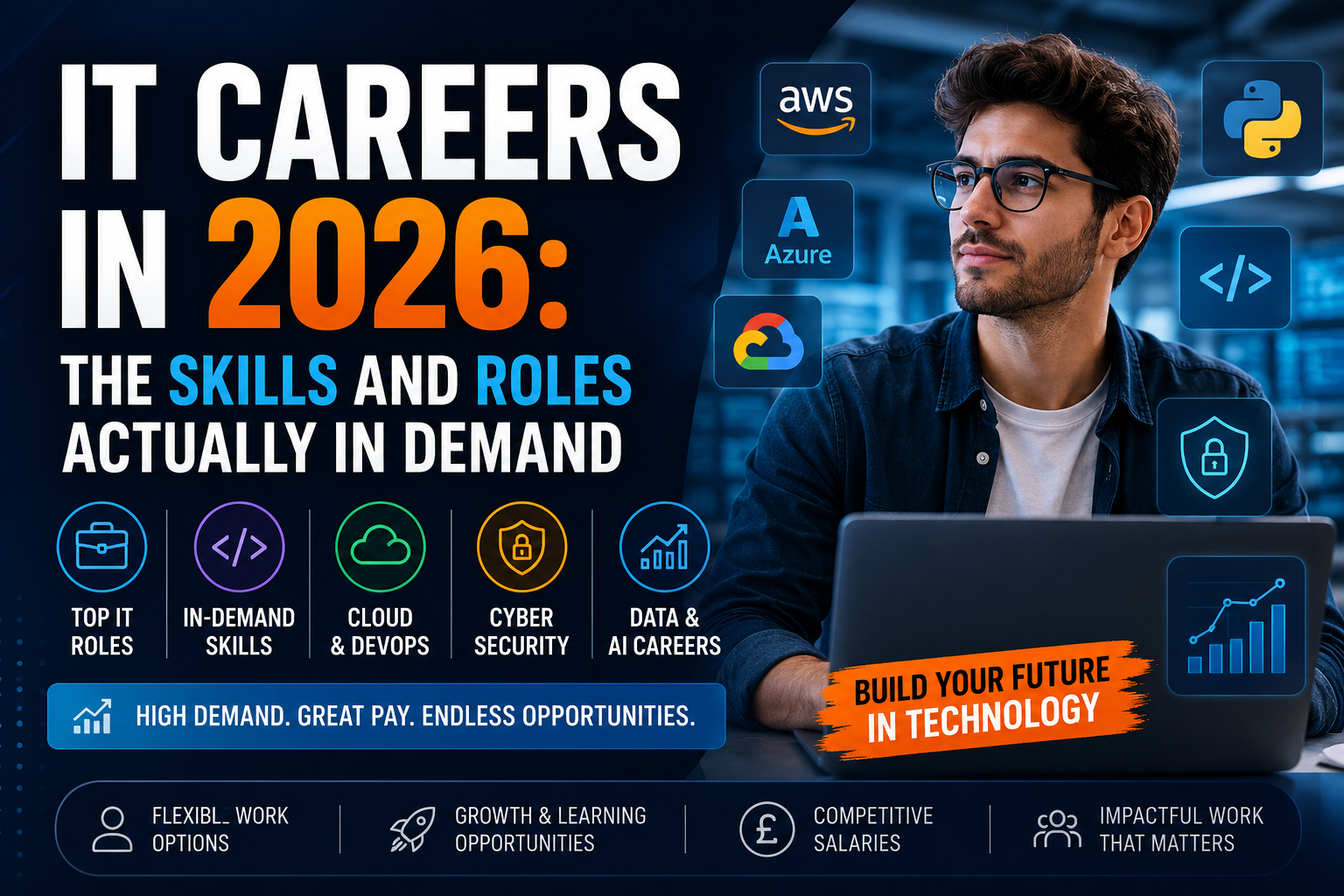
IT Careers in 2026: The Skills and Roles Actually in Demand
Nobody needs convincing that IT is a growing field anymore. What's less obvious is which roles are actually hiring right now, and what it takes to get through the door. That's what this is about.
Why IT keeps growing
Every business is, in some sense, a technology business now. Hospitals run on software. Retailers live or die by their supply chain systems. Banks are rebuilding core infrastructure around cloud platforms. None of that happens without people who can build it, secure it, and keep it running.
Companies keep spending on cloud computing, cybersecurity, AI, data and automation because the alternative is falling behind their competitors. That spending is what's behind the steady stream of open roles across the sector, whether you're finishing a degree, several years into a career already, or switching in from somewhere else entirely.
The roles getting the most attention right now
A handful of titles keep showing up across job boards and hiring plans:
- Software Developer
- Full-Stack Developer
- Cybersecurity Analyst
- Cloud Engineer
- Data Analyst
- Data Scientist
- DevOps Engineer
- AI and Machine Learning Engineer
- Network Engineer
- IT Support Specialist
- Systems Administrator
- Business Analyst
- Quality Assurance (QA) Engineer
- UI/UX Designer
- Solutions Architect
Most of these come with decent pay, some flexibility around how and where you work, and a fairly clear route upward if you stick with it.
What employers are actually screening for
Technical ability still gets your CV noticed, but it's rarely the only thing that gets you hired anymore. Employers want people who can do the job and work well with the team around them.
On the technical side, this usually means:
- Programming languages such as Python, Java, JavaScript, and C#
- Cloud platforms, particularly AWS, Azure, and Google Cloud
- Cybersecurity fundamentals
- SQL and database management
- Data analysis and visualisation
- AI and automation tools
- DevOps practices and CI/CD
- Version control using Git
The skills that get overlooked, but shouldn't be, are the ones that don't fit neatly on a certificate:
- Communication
- Teamwork
- Critical thinking
- Problem-solving
- Adaptability
- Time management
- Willingness to keep learning
Remote and hybrid work is just normal now
Tech was one of the first industries to properly embrace remote and hybrid work, and it hasn't gone back. Plenty of companies now hire remote-first, run flexible schedules, or recruit across borders entirely, because location matters far less than it used to when the work happens on a screen.
If you're job hunting, a few things actually move the needle
- Keep your skills current. Tools and frameworks move fast in this field.
- Build a portfolio of real projects, not just a list of technologies you've heard of.
- Get certifications where they're genuinely relevant to the role, not just for the sake of having one.
- Tailor your CV for each application instead of sending the same one everywhere.
- Prepare for both the technical test and the behavioural interview. Employers ask about both.
- Put some effort into your online presence, whether that's LinkedIn, GitHub, or a portfolio site.
Why bother with a career in IT
The pay is good, but that's rarely the whole reason people stay in tech. It's the chance to actually solve problems, work with tools that are genuinely new, and build things that get used by real people. Combine that with strong demand and a lot of room to keep learning, and it's easy to see why IT stays near the top of the list for people planning a long-term career.
Ready to find your next role?
Whether this is your first job in tech or your next move, browse the latest IT vacancies on FastJobSearch and connect with employers hiring across software development, cybersecurity, cloud, data, and infrastructure.
_6a5a11e7cca77_1784287719.png)